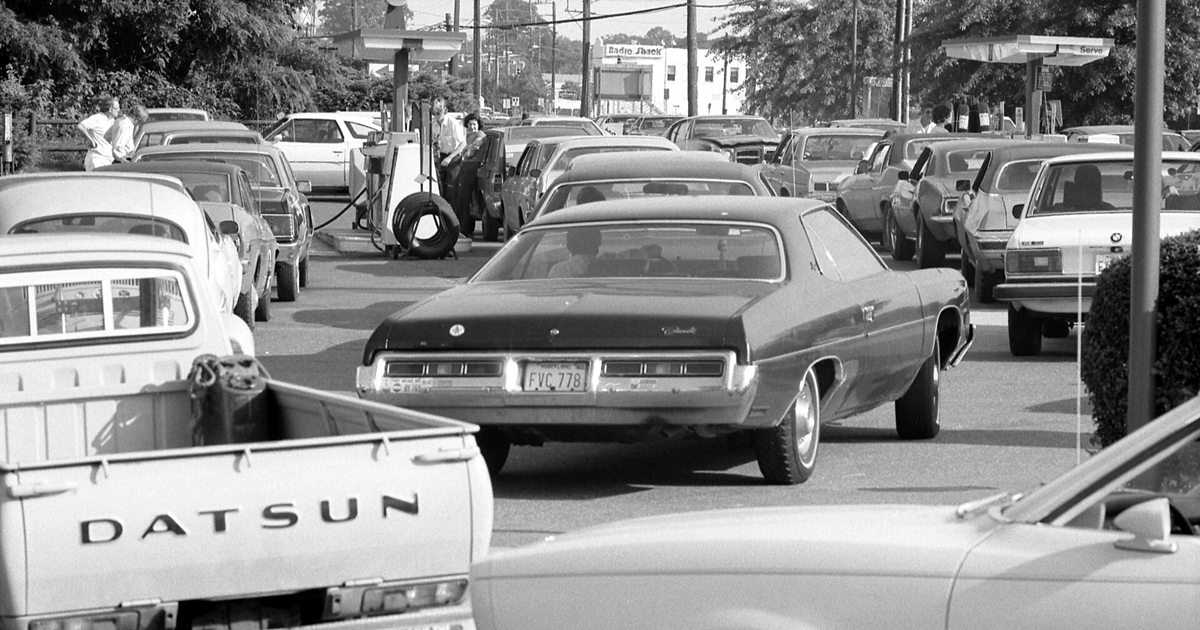
Photo: Warren K. Leffler / Wikimedia Commons (public domain)
What Is Stagflation? A Plain-English Guide, What Happened in the 1970s, and How to Invest Through It
Stagflation is a mix of stagnation and inflation: prices rise quickly while economic growth slows or stalls and unemployment rises. It's hard to fix because the usual cure for inflation, raising interest rates, also slows the economy further, while the usual cure for a weak economy, cutting rates, can push prices even higher. The classic example is the 1970s, when oil shocks in 1973 and 1979 helped drive US inflation to 13.5% in 1980 and the Federal Reserve under Paul Volcker raised rates to about 20% to break it. In 2026, an oil shock has pushed US inflation to 3.7% and euro zone inflation to 3.8%, while consumer spending is softening, so economists are using the word again, although unemployment is far lower than in the 1970s. Historically, commodities, energy stocks, gold and inflation-protected bonds have held up better in stagflation than long-term bonds and expensive growth stocks.
What is stagflation?
Stagflation is an economy that's stuck in the worst of both worlds:
- Inflation is high, so prices keep rising.
- Growth is slow or negative, so the economy stalls.
- Unemployment tends to rise.
The word was coined in the 1960s in Britain by combining "stagnation" and "inflation." It became famous in the 1970s, when the US, Canada and Europe all lived through it.
In a normal business cycle, inflation and growth move together. A hot economy pushes prices up. A weak one pulls them down. Stagflation breaks that rule, which is why it's so painful and so hard to fix.
What causes it?
1. Supply shocks
The classic trigger is a sudden jump in the cost of something everyone needs, usually energy. When oil prices spike:
- Gas, heating, airfares and shipping cost more, so prices rise.
- Households have less left to spend on everything else, and companies' costs jump, so growth slows.
2. Loose money for too long
If central banks keep rates low while prices rise, inflation can become entrenched.
3. Expectations
Once people expect prices to keep rising, workers demand bigger raises and companies raise prices pre-emptively. Inflation feeds on itself. Central banks watch inflation expectations closely for this reason.
The 1970s: the textbook case
| Year | What happened |
|---|---|
| 1973-74 | OPEC oil embargo; oil prices roughly quadrupled. US recession. |
| 1974 | US inflation passes 12% |
| 1973-74 | S&P 500 falls about 48% |
| 1979 | Iranian revolution; second oil shock and gas lines |
| 1980 | US inflation peaks at about 13.5% for the year |
| 1979-81 | Fed chair Paul Volcker raises rates to about 20% |
| 1981-82 | Deep recession; unemployment tops 10% |
| 1982 onward | Inflation falls sharply; a long bull market begins |
Sources: Federal Reserve History, Bureau of Labor Statistics.
The photo at the top of this page shows a gas station line in June 1979, when the second oil shock caused shortages across the US.
The lesson policymakers took from the 1970s: let inflation run, and it gets much more expensive to stop later. That's why central banks in 2026 have raised rates even as growth has slowed.
Is 2026 a stagflation year?
Some of the ingredients are back:
- Oil shock: The war involving Iran and attacks on Gulf shipping have kept oil above $100. Brent hit about $111 on October 20 (details).
- Rising inflation: US inflation hit 3.7% in September, Canada 3.1%, the euro zone 3.8%.
- Softer real demand: US retail sales rose 0.8% in September, but the core "control group" rose only 0.1% (why).
- Rate hikes into weakness: The Fed, ECB and others have raised rates this year despite slowing growth.
But there are big differences from the 1970s:
- Core inflation is much lower. US core inflation was 2.6% in September. Canada's preferred core measures were around 2%. That suggests the shock hasn't spread into everything yet. See core vs headline inflation.
- Unemployment is far below 1970s levels.
- Central banks are independent and inflation-targeting, which helps keep expectations anchored.
So most economists describe 2026 as a stagflationary shock, not full-blown 1970s stagflation. The risk is that it lasts long enough to change expectations.
How different investments have behaved
| Asset | Typical stagflation performance | Why |
|---|---|---|
| Commodities and energy stocks | Strong | They are the inflation |
| Gold | Strong when real yields fall; weak when they rise | Store of value with no yield |
| Inflation-protected bonds (TIPS, real return bonds) | Relatively good | Principal adjusts with inflation |
| Short-term T-bills and cash | OK | Rates reset upward quickly |
| Consumer staples, utilities | Mixed to OK | Some can pass on costs |
| Long-term fixed-rate bonds | Weak | Inflation and rising rates erode value |
| High-valuation growth stocks | Weak | Higher rates shrink the value of future profits |
A note on gold: it soared in the 1970s, but in 2026 it's well below its January record because real yields have risen. That shows the "it depends" is real. Our report on why gold isn't working as a safe haven this time explains.
How to protect your portfolio
- Diversify across asset types. A portfolio with some exposure to commodities, energy and inflation-protected bonds is better balanced than one that's all tech stocks and long bonds.
- Keep cash productive. Short-term T-bills, money market funds and high-yield savings reprice quickly when rates rise.
- Favour companies with pricing power. Firms that can raise prices without losing customers hold up best.
- Don't abandon stocks. Over decades, stocks have beaten inflation. Investors who kept buying through the 1970s were set up for the 1980s and 1990s bull market.
- Avoid big bets on one outcome. Stagflation scares often fade if oil falls.
The bottom line
Stagflation is rising prices plus a stalling economy, usually set off by an energy shock. It's hard for central banks to fix and hard on traditional stock-and-bond portfolios. 2026 has some of the ingredients but not yet the full recipe. The best defence is a diversified portfolio, productive cash and the patience to keep investing.
This article is educational and not personalized investment advice.
Frequently asked questions
What is stagflation in simple terms?
Stagflation is when prices rise quickly at the same time as the economy slows down and unemployment goes up. Normally inflation comes with a strong economy and falls in a weak one. Stagflation is the unusual and painful case where you get high prices and weak growth together.
What causes stagflation?
The most common cause is a supply shock, especially a sudden jump in oil or energy prices. Higher energy costs raise prices across the economy while squeezing household budgets and company profits, which slows growth. Loose monetary policy and expectations of ever-rising prices, as in the 1970s, can make it last longer.
Why is stagflation so hard to fix?
Central banks have one main tool, interest rates. Raising rates fights inflation but slows the economy further. Cutting rates supports growth but risks more inflation. In stagflation, every choice hurts something. In the early 1980s the Fed chose to crush inflation with rates near 20%, which caused a deep recession.
Is the US in stagflation in 2026?
Not fully, but the risk has risen. An oil shock has pushed inflation to 3.7% in September 2026 while underlying retail spending barely grew. However, unemployment is far below 1970s levels and the economy is still growing. Some economists describe it as a mild stagflationary shock rather than true stagflation.
What investments do well during stagflation?
Historically, commodities, energy producers, gold and inflation-protected bonds such as TIPS have held up better than most assets. Companies with pricing power, such as some consumer staples and utilities, have done relatively well. Long-term fixed-rate bonds and high-valuation growth stocks have tended to suffer.
How did stocks do in the 1970s?
Poorly after inflation. The S&P 500 fell about 48% from early 1973 to late 1974, and over the whole decade stock returns barely beat inflation. Investors who kept buying through the period, however, were well positioned for the long bull market that began in 1982.
What's the difference between stagflation and recession?
A recession is a broad decline in economic activity. In most recessions inflation falls because demand weakens. In stagflation, inflation stays high or rises even as growth weakens. A stagflationary period can include a recession, as in 1974-75 and 1980-82.
Primary sources
Data & disclaimer: This article is for educational purposes only and is not financial or investment advice. Figures reflect data available as of Oct 20, 2026, and conditions change — always confirm current pricing, rates and rules with the provider before you act. Written by Elizabeta Dimoska. See our editorial standards and disclosure.
Comments