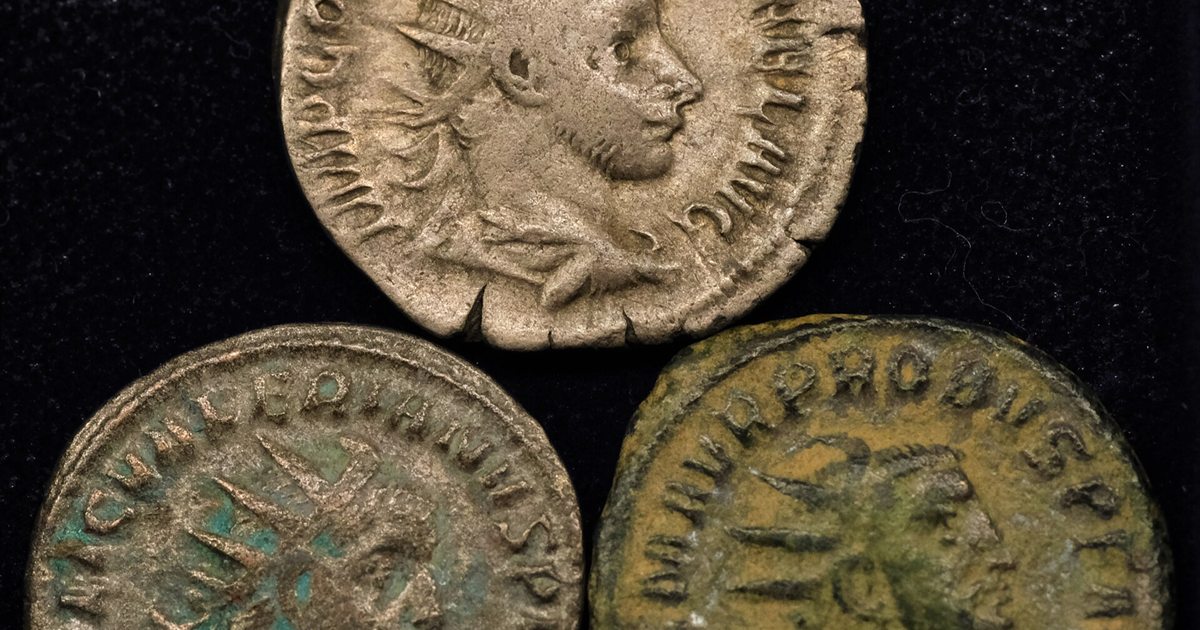
Photo: MonaghanNumismatics / Wikimedia Commons, CC BY-SA 4.0, cropped
What Is Inflation? A Simple Explanation, and the 2,000-Year Story of Who 'Invented' It
Inflation is a general rise in prices across the economy, which means each dollar buys a little less over time. If inflation is 3%, something that costs $100 today costs about $103 a year from now. Nobody invented inflation. It has happened for as long as money has existed, whenever the amount of money grows faster than the goods and services it can buy. Roman emperors caused one of the first recorded inflations by mixing cheap metal into silver coins, and China's early paper money caused another. What was invented was the word, used for money in the US by the mid-1800s, and the measurement: the US Consumer Price Index dates back to 1913. Today most central banks aim for about 2% inflation a year. US inflation was 3.7% in September 2026.
What is inflation?
Inflation is the general rise in prices across an economy over time. When prices go up, each dollar in your pocket buys a little less. Economists call that a loss of purchasing power.
A simple example. Say a basket of groceries costs $100 today:
| Inflation rate | Same basket in 1 year | In 10 years | In 25 years |
|---|---|---|---|
| 2% | $102 | $122 | $164 |
| 3% | $103 | $134 | $209 |
| 3.7% | $104 | $144 | $248 |
| 10% | $110 | $259 | $1,083 |
Flip it around and you see the damage to savings. At 3% inflation, $100 sitting in a drawer buys only about $74 worth of groceries after 10 years.
Inflation is usually reported as a yearly percentage. In the United States, prices were 3.7% higher in September 2026 than a year earlier. See our report on the September CPI.
Inflation, deflation and the other "-flations"
| Term | What it means | Example |
|---|---|---|
| Inflation | Prices rising | US 2026: 3.7% |
| Disinflation | Prices still rising, but more slowly | Inflation falling from 6% to 3% |
| Deflation | Prices falling | Japan for much of 1999–2012 |
| Stagflation | High inflation plus weak growth and high unemployment | US in the 1970s |
| Hyperinflation | Extremely fast inflation, often 50% or more a month | Germany 1923, Zimbabwe 2008 |
What causes inflation?
Economists group the causes into three types:
- Demand-pull inflation. Everyone wants to buy more than the economy can produce. Sellers raise prices because they can. This happened after the pandemic, when savings and stimulus met empty shelves.
- Cost-push inflation. It costs more to make things, so prices rise. Oil is the classic example. When crude jumps, fuel, airfares, shipping and plastics all follow. That's what drove 2026's rise.
- Built-in inflation. Once people expect prices to rise, workers ask for raises and businesses raise prices in advance. Expectations feed on themselves. Central banks fear this one most.
Behind all three sits one old idea: when the amount of money grows faster than the amount of stuff to buy, each unit of money is worth less. That idea is the key to the history.
Who invented inflation? Nobody, but here's who caused it first
Inflation wasn't invented like the light bulb. It was discovered, the hard way, over and over, by people and governments who created too much money. Here's the 2,000-year story.
Ancient Rome: shaving the silver (1st to 3rd century AD)
Rome paid its soldiers and officials in silver coins called denarii. Under Emperor Augustus, around the year 1 AD, the denarius was nearly pure silver.
Then emperors found a shortcut. When they needed more money for armies and building, they mixed cheaper metals into the coins. Nero began cutting the silver around 64 AD. Over the next two centuries the cuts kept coming. By the 270s, Rome's main silver coin contained only a few percent silver.
People noticed. Merchants raised prices for the "new" coins. Prices across the empire soared in the third century.
In 301 AD, Emperor Diocletian tried to fix it by law. His Edict on Maximum Prices set price caps on more than a thousand goods and wages, with the death penalty for breaking them. It failed. Goods vanished from markets, and the law was soon ignored. It is one of history's first lessons that you can't legislate inflation away.
China: the first paper-money inflation (11th to 14th century)
China invented paper money. Merchants in Sichuan used paper notes called jiaozi in the early 1000s, and the government soon took over printing them.
Paper money is wonderfully convenient. It's also dangerously easy to print. Under the Yuan dynasty, founded by Kublai Khan, the government printed more and more notes to pay its bills. By the mid-1300s the notes had lost most of their value. The following Ming dynasty eventually gave up on paper money and returned to silver.
Europe's "Price Revolution" (16th century)
After 1545, Spain began shipping enormous amounts of silver from the mines of Potosí in today's Bolivia. Europe suddenly had far more money, but not far more goods.
Prices across Europe rose for about 150 years. In some countries they rose roughly sixfold. That works out to only 1% to 2% a year, which sounds small today but was shocking to people used to stable prices for generations.
The first people to explain it
This is where inflation gets its first "inventors", the thinkers who worked out why it happens:
- Nicolaus Copernicus, the Polish astronomer who put the Sun at the centre of the solar system, also wrote an essay on money in 1526. He noted that money loses value when there's too much of it. It was one of the earliest statements of the idea.
- Martín de Azpilcueta, a Spanish priest of the School of Salamanca, linked the flood of American silver to rising prices in 1556.
- Jean Bodin, a French philosopher, made the same argument in 1568. Historians often credit him with an early version of the quantity theory of money.
- David Hume, the Scottish philosopher, explained in 1752 how new money spreads through an economy and pushes up prices.
- Irving Fisher, an American economist, wrote it as an equation in 1911: MV = PT. Money times how fast it circulates equals prices times the number of transactions. More money, same goods, higher prices.
- Milton Friedman summed it up in the 20th century: inflation is "always and everywhere a monetary phenomenon."
America's early inflations
- The Revolutionary War (1770s–1780s). The Continental Congress printed so much paper money, the "Continental", that it became nearly worthless. The phrase "not worth a Continental" survived for generations.
- The world's first inflation-protected bonds (1780). Massachusetts paid its soldiers with notes whose value was tied to the price of a basket of corn, beef, wool and leather, so inflation couldn't erode their pay. It was an early ancestor of today's TIPS.
- The Civil War (1860s). The Union printed "greenbacks" and the Confederacy printed so much money that Southern prices soared to many times their pre-war level.
Where the word "inflation" came from
The word comes from the Latin inflare, "to blow into" or "puff up", the same root as inflating a balloon.
By the mid-1800s, Americans were using it for money, in phrases like "inflation of the currency". At first it meant an increase in the amount of paper money, like blowing air into a balloon. Only over the 20th century did "inflation" come to mean what most people mean today: rising prices, the result rather than the cause.
How inflation is measured
Before anyone could fight inflation, someone had to measure it.
- 1707: English bishop William Fleetwood compared the prices of wheat, beer, cloth and other goods over centuries, to work out what an old sum of money was worth in his day. It's often called one of the first price indexes.
- 1913 to 1919: The US Bureau of Labor Statistics began publishing a cost-of-living index during the First World War, when wartime prices were climbing. Its national figures reach back to 1913. That index became the Consumer Price Index (CPI).
Today the BLS collects about 80,000 prices every month for the CPI basket, from rent and groceries to airfares and haircuts, and is published every month. Canada's equivalent comes from Statistics Canada, and most countries have one.
Economists also watch core inflation, which leaves out food and energy because they swing so much. In September 2026, US headline inflation was 3.7% but core was only 2.6%, because most of the jump came from gasoline.
Inflation's most famous disasters
| When | Where | How bad |
|---|---|---|
| 1923 | Germany (Weimar Republic) | By November, one US dollar = about 4.2 trillion marks |
| 1946 | Hungary | Worst on record: prices doubled about every 15 hours |
| 1970s | United States | US inflation peaked at 14.8% in March 1980 |
| 2008 | Zimbabwe | The government printed a 100 trillion dollar note |
| 2022 | US and Canada | US inflation hit 9.1%, Canada 8.1%, the highest in about 40 years |
The US "Great Inflation" of 1965 to 1982 ended only when Fed Chair Paul Volcker raised interest rates to near 20% in 1981, causing a deep recession. It taught central banks that once inflation gets built into expectations, it's very painful to remove.
The modern answer: the 2% target
After the 1970s, central banks looked for a better rule. New Zealand adopted the world's first formal inflation target in 1990. Canada followed in 1991, and today the Bank of Canada aims for 2%. The US Federal Reserve formally adopted a 2% target in 2012.
Why 2% and not zero?
- A safety buffer against deflation. Falling prices sound nice, but they make people delay purchases and make debts harder to repay. Japan spent years stuck in deflation.
- Room to cut rates. With some inflation, interest rates sit high enough that the central bank can cut them in a recession.
- Measurement isn't perfect. Official indexes may slightly overstate true inflation, because products improve over time.
Central banks fight inflation mainly by raising interest rates. Higher rates make borrowing more expensive, which cools spending and, eventually, prices. That's why the Fed raised rates in September 2026.
What inflation means for your money
Inflation is the silent tax on savings. Here's how different places to keep money have held up against it:
| Where your money sits | Against inflation over the long run |
|---|---|
| Cash in a drawer | Loses every year |
| Regular savings account | Usually loses after inflation |
| High-yield savings, T-bills, money market funds | Roughly keeps pace when rates are high |
| Inflation-protected bonds (US TIPS, I bonds) | Designed to match inflation |
| Gold | Mixed: great in some decades, flat in others |
| Real estate | Often keeps pace over long periods |
| A diversified stock portfolio | Has historically beaten inflation by the widest margin over decades |
The key idea is your real return: what you earn after inflation. A 5% return with 3.7% inflation is only about a 1.3% real gain. Our guide on what inflation does to compound growth runs the numbers.
Five ways to protect yourself from inflation
- Don't hold too much cash. Keep an emergency fund, then put the rest to work. See whether your savings account is losing money.
- Earn a real rate on cash. T-bills, money market funds and the best high-yield accounts pay more than they used to. Here's how to buy Treasury bills.
- Own stocks for the long term. Companies can raise their prices, so their profits tend to grow with inflation over time. A low-cost index fund is the simplest way. Start with what an ETF is.
- Consider inflation-linked bonds for part of your safe money.
- Use the Rule of 72. Divide 72 by the inflation rate to see how fast prices double. At 3%, prices double in 24 years. At 3.7%, in under 20. That's how much your savings need to grow just to stand still.
The bottom line
Inflation isn't a modern invention. It's what happens whenever money grows faster than the things it buys, from Roman silver coins to Chinese paper notes to today's oil shock. What people invented over 2,000 years were the explanations, the word, the measurements and finally the 2% target that central banks use today.
For investors, the lesson hasn't changed since Diocletian: you can't stop inflation by wishing it away. You protect yourself by making sure your money earns more than prices rise.
Frequently asked questions
What is inflation in simple terms?
Inflation is the rise in the general level of prices over time. When there is inflation, the same amount of money buys fewer goods and services than it did before. It is usually measured as the percentage change in a price index, such as the Consumer Price Index, over 12 months.
Who invented inflation?
No one invented inflation. It is a natural result of money losing value when its supply grows faster than the goods it can buy. Early examples include the Roman Empire, where emperors reduced the silver in coins, and China's Yuan dynasty, which printed too much paper money. What people invented were explanations, the word itself and ways to measure it.
When was the word inflation first used for money?
The word comes from the Latin inflare, meaning to blow into or puff up. It was used in the United States by the mid-1800s, mainly in phrases like inflation of the currency, to describe an expansion of paper money. Over the 20th century its meaning shifted to the rise in prices that usually follows.
What causes inflation?
There are three main causes. Demand-pull inflation happens when people and businesses want to buy more than the economy can produce. Cost-push inflation happens when production costs, such as oil or wages, rise and get passed on. Built-in inflation happens when people expect higher prices and demand higher wages, which feeds more price increases. Too much money chasing too few goods sits behind all three.
Why do central banks target 2% inflation instead of 0%?
A little inflation gives central banks room to cut interest rates in a downturn and avoids deflation, where falling prices cause people to delay spending and debts become harder to repay. New Zealand adopted the first formal inflation target in 1990, Canada followed in 1991, and the US Federal Reserve formally adopted 2% in 2012.
What was the worst inflation in history?
Hungary in 1946 holds the record. At its peak, prices doubled roughly every 15 hours. Other famous hyperinflations include Germany in 1923, when a US dollar was worth about 4.2 trillion marks, and Zimbabwe in 2008, which printed a 100 trillion dollar banknote.
How can I protect my money from inflation?
Keep emergency cash in accounts paying close to or above inflation, such as high-yield savings, money market funds or Treasury bills. For long-term money, a diversified stock portfolio has historically beaten inflation over long periods. Inflation-protected bonds such as US TIPS and I bonds adjust with prices. Cash under the mattress is the worst option.
Primary sources
- US Bureau of Labor Statistics — Consumer Price Index: frequently asked questions and history
- US Bureau of Labor Statistics — Consumer Price Index Summary, September 2026
- Federal Reserve — Why does the Federal Reserve aim for inflation of 2 percent over the longer run?
- Federal Reserve History — The Great Inflation, 1965–1982
- Bank of Canada — Inflation-control target
- International Monetary Fund — Inflation: prices on the rise (Back to Basics)
- Reserve Bank of New Zealand — History of inflation targeting
Data & disclaimer: This article is for educational purposes only and is not financial or investment advice. Figures reflect data available as of Oct 14, 2026, and conditions change — always confirm current pricing, rates and rules with the provider before you act. Written by Elizabeta Dimoska. See our editorial standards and disclosure.
Comments