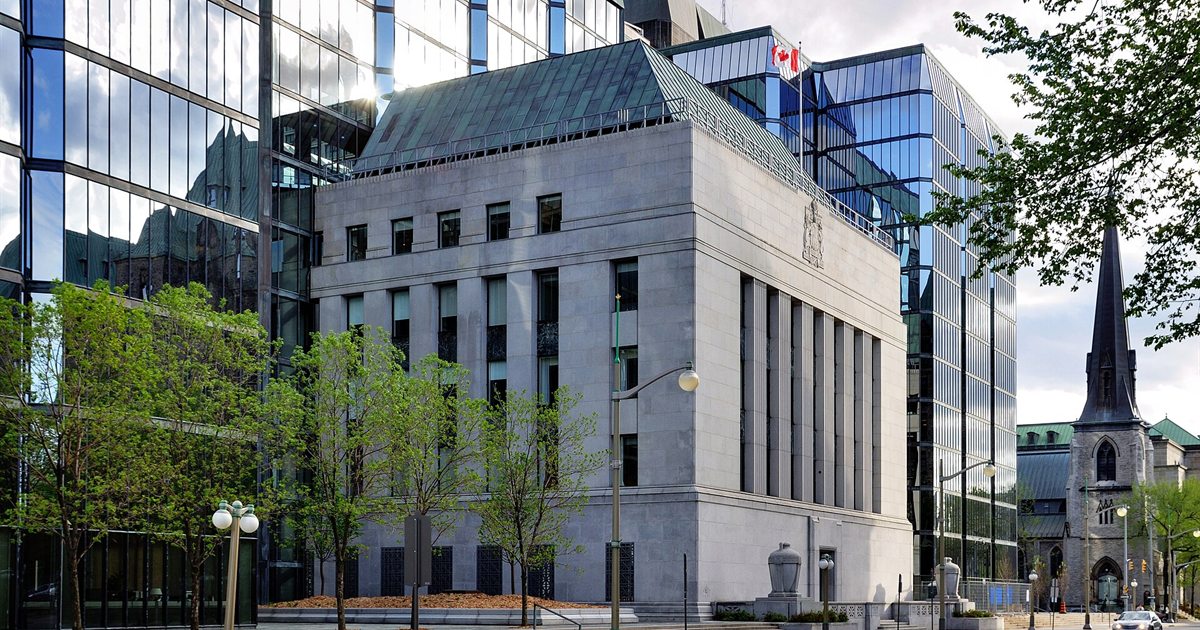
Photo: Wladyslaw / Wikimedia Commons, CC BY-SA 3.0, cropped
Canada's Economy Stalled in July. Will the Bank of Canada Still Raise Rates on October 28?
- Canada's real GDP was unchanged (0.0%) in July 2026, Statistics Canada reported on September 29. Ten of 20 industries grew.
- Manufacturing fell 0.9%, retail fell 1.0%, and mining, oil and gas fell 0.5%. Construction rose 1.3% and utilities rose 1.7%.
- StatCan's early estimate for August is growth of 0.2%. The full report comes October 30, two days after the rate decision.
- The Bank of Canada's policy rate is 2.25%, where it has been since October 2025. Headline inflation is running near 3%, mostly because of gasoline.
- Markets are divided on October 28. Estimates published this week ranged from a 74% chance of a hold to roughly a coin flip on a 0.25-point hike.
Zero growth
Statistics Canada reported on September 29 that the economy went nowhere in July. Real GDP was unchanged from June.
Here's what moved:
| Industry | July change |
|---|---|
| Utilities | +1.7% |
| Construction | +1.3% |
| Accommodation and food services | +0.8% |
| Mining, oil and gas | -0.5% |
| Manufacturing | -0.9% |
| Retail trade | -1.0% |
The good news has an asterisk. Non-residential construction jumped 2.9%, its best month since January 2022, but analysts at Better Dwelling noted most of that came from a single Ontario hospital project. That's not something you can count on every month.
The bad news is broad. Factories, stores and wholesalers all shrank. And July came before the latest round of the trade fight with the United States, when Canada's counter-tariffs took effect in September.
One bright spot: revisions showed the first half of 2026 was a little stronger than first reported, and StatCan's early read on August is growth of 0.2%.
The Bank of Canada's problem
The Bank of Canada sets interest rates to keep inflation near 2%. Right now it's being pulled in two directions.
The case for holding at 2.25%: the economy is barely growing. Raising rates into a stall makes a recession more likely.
The case for raising rates: inflation is running near 3%, mostly because high oil prices have pushed up gasoline. If people start to expect 3% inflation, it gets harder to bring down.
Markets can't agree. One measure this week put the odds of a hold at about 74%. Others had a hike at close to 50/50. Either way, it's a big shift from late August, when a hold was seen as almost certain.
There's an awkward timing issue too. The full August GDP report comes out on October 30, two days after the decision. The Bank will decide without it.
What it means for your mortgage
Variable-rate mortgages move with the Bank of Canada. A 0.25-point hike adds roughly $13 to $15 a month for every $100,000 you owe.
Fixed-rate mortgages follow bond yields, not the Bank directly. Canadian bond yields have been pulled up by the US, where long-term Treasury yields just hit a 24-year high. So fixed rates have been rising regardless of what the Bank does.
If you're renewing soon:
- Ask your lender for a rate hold now. Most last 90 to 120 days and cost nothing.
- Test your budget at a rate half a point higher than today.
- Don't choose based on a forecast. Choose based on what you can afford if you're wrong.
What it means for your savings
Higher-for-longer rates are good for savers. GIC and savings rates tend to rise when the market expects hikes. If you have cash you won't need for a year or more, compare your options in GICs vs High-Interest Savings vs Cash ETFs.
What it means for investors
A flat month of GDP isn't a reason to change a long-term portfolio. The TSX is driven mostly by banks, energy and gold, and it's still up about 16.6% over the past year even after a 2.6% dip in the last month.
If you're building a portfolio from scratch, an all-in-one ETF spreads your money around the world so that one slow Canadian quarter doesn't matter much. And if you want US exposure, see how to buy the S&P 500 in Canada.
Dates to circle
- Mid-October: September CPI inflation
- October 28: Bank of Canada decision and Monetary Policy Report
- October 30: August GDP
Frequently asked questions
Did Canada's economy grow in July 2026?
No. Statistics Canada reported that real GDP was essentially unchanged in July 2026. Gains in construction and utilities were offset by declines in manufacturing, retail and mining.
When is the next Bank of Canada interest rate announcement?
Wednesday, October 28, 2026, at 9:45 a.m. Eastern. The Bank will also publish its Monetary Policy Report that day.
Will the Bank of Canada raise rates in October 2026?
It's uncertain. The economy is weak, which argues for holding at 2.25%. But inflation is near 3%, above the Bank's 2% target, which argues for a hike. Market estimates this week ranged from about a 74% chance of a hold to roughly even odds of a hike. September inflation data, due before the meeting, will matter a lot.
Should I lock in my variable mortgage?
It depends on your budget, not on a forecast. If a 0.25 or 0.50 point increase would strain your monthly cash flow, locking in buys certainty. If you have room in your budget, staying variable keeps your options open. Ask your lender what your payment would be at a rate half a point higher before you decide.
What does flat GDP mean for the TSX?
Less than you might think. The TSX is dominated by banks, energy and mining companies whose profits depend on global prices and interest rates more than on one month of Canadian GDP. The index closed at about 35,155 on October 1, down 2.6% over the past month but still up about 16.6% from a year ago.
Primary sources
Data & disclaimer: This article is for educational purposes only and is not financial or investment advice. Figures reflect data available as of Oct 3, 2026, and conditions change — always confirm current pricing, rates and rules with the provider before you act. Written by Elizabeta Dimoska. See our editorial standards and disclosure.
Comments