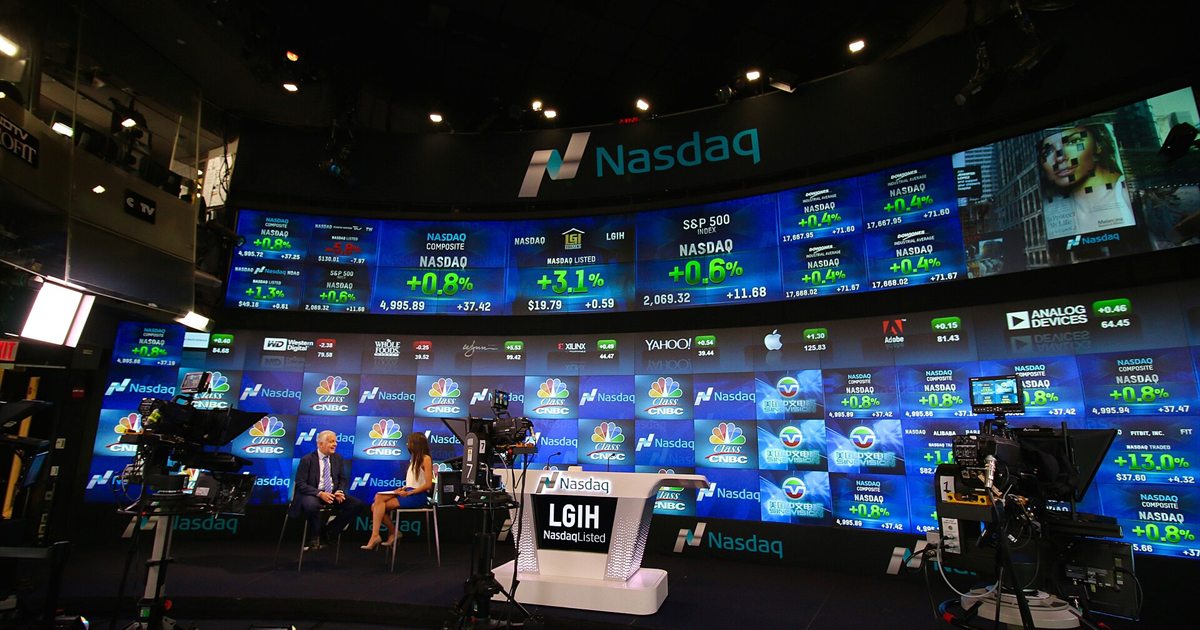
Photo: Luca Marfè at Italia all'ONU / Wikimedia Commons, CC BY 2.0, cropped
Best Nasdaq-100 ETFs in Canada (October 2026): QQC vs HXQ vs ZQQ vs XQQ vs ZNQ, Ranked by Cost
The cheapest Nasdaq-100 ETF in Canada is Invesco's QQC, with a management fee of 0.20%, unhedged. If you want currency hedging, QQC.F is the lowest-cost hedged option at about 0.20%–0.21%. Global X's HXQ (management fee 0.25%, MER about 0.28%) is a corporate-class ETF that pays no distributions, which makes it tax-efficient in a non-registered account. ZQQ and XQQ are the older, larger hedged funds but cost about 0.39% MER. In an RRSP, US-listed QQQM or QQQ avoid US withholding tax on dividends, but you'll need US dollars. Remember the Nasdaq-100 is concentrated: its largest holdings are a handful of giant tech companies.
What the Nasdaq-100 is
The Nasdaq-100 is an index of the 100 largest non-financial companies listed on the Nasdaq stock exchange. It's dominated by technology and tech-like companies, including Apple, Microsoft, Nvidia, Amazon, Alphabet and Meta.
The most famous fund that tracks it is QQQ in the US. Canadians can buy the same index on the TSX, in Canadian dollars, through several ETFs.
The comparison
| ETF | Provider | Currency hedged? | Management fee | MER (approx.) | Distributions |
|---|---|---|---|---|---|
| QQC | Invesco | No | 0.20% | About 0.2% | Yes, small |
| QQC.F | Invesco | Yes | 0.20% | About 0.21% | Yes, small |
| HXQ | Global X | No | 0.25% | About 0.28% | None (corporate class) |
| ZNQ | BMO | No | 0.35% | About 0.39% | Yes, small |
| XQQU | iShares | No | 0.35% | About 0.39% | Yes, small |
| ZQQ | BMO | Yes | 0.35% | About 0.39% | Yes, small |
| XQQ | iShares | Yes | 0.35% | About 0.39% | Yes, small |
Sources: provider websites and fact sheets, 2026. MERs are taken from each fund's latest financial reports and change over time; check the provider's page before buying.
On $10,000, the difference between a 0.20% fee and a 0.39% fee is about $19 a year. Over 25 years of growth, that gap compounds into a meaningful amount.
1. QQC: lowest cost overall
Invesco is the company behind the US-listed QQQ, and QQC is its Canadian version. A 0.20% management fee makes it the cheapest way to own the Nasdaq-100 on the TSX.
It's unhedged, so it moves with the US dollar. When the Canadian dollar falls, as it has in 2026 toward an 18-month low, unhedged funds get a boost.
Best for: most long-term investors in a TFSA or FHSA.
2. QQC.F: cheapest hedged option
QQC.F is the hedged twin of QQC, at a similar low fee. Hedging removes most of the effect of the US dollar moving against the Canadian dollar.
Best for: investors who want pure Nasdaq-100 returns without currency swings. Not sure which you need? Read hedged vs unhedged ETFs.
3. HXQ: most tax-efficient in a taxable account
HXQ is a corporate-class ETF. Instead of paying out dividends, it reflects them in its price. In a non-registered account, that generally means no yearly taxable distributions; you pay tax on the gain when you sell.
It costs a little more (management fee 0.25%, MER about 0.28%). Inside a TFSA or RRSP, where tax doesn't matter, QQC is cheaper.
Best for: non-registered accounts.
4. ZQQ and XQQ: the big, established hedged funds
BMO's ZQQ and iShares' XQQ were among the first Nasdaq-100 ETFs in Canada. They're large and trade heavily, which keeps bid-ask spreads tight. But at about 0.39% MER, they cost nearly twice as much as QQC.F for the same hedged exposure.
Best for: investors who already own them. Switching in a taxable account could trigger a capital gain, so weigh that first.
5. ZNQ and XQQU: unhedged, but pricier
BMO's ZNQ and iShares' XQQU are unhedged like QQC but cost about twice as much. There's little reason to choose them over QQC for a new purchase.
What about buying QQQ or QQQM directly?
You can buy the US-listed funds through most Canadian brokers:
| Canadian-listed (QQC) | US-listed (QQQM / QQQ) | |
|---|---|---|
| Currency | Canadian dollars | US dollars |
| Fee | 0.20% | QQQM about 0.15%; QQQ about 0.2% |
| Currency conversion | None | About 1.5% each way at many brokers |
| US withholding tax in an RRSP | Applies | Exempt under the tax treaty |
| Best account | TFSA, FHSA, small amounts | RRSP, if you already hold US dollars |
The Nasdaq-100's dividend yield is small, so the withholding-tax advantage is modest. The currency conversion fee usually matters more. See US dividend withholding tax in a TFSA, RRSP and FHSA and the cheapest way to buy US stocks from Canada.
Which account to hold it in
| Account | Best choice | Why |
|---|---|---|
| TFSA | QQC or QQC.F | Lowest fee, no currency conversion |
| FHSA | QQC or QQC.F | Same reasons |
| RRSP | QQC, or QQQM if you hold US dollars | US-listed avoids withholding tax |
| Non-registered | HXQ | No yearly taxable distributions |
The risk: concentration
The Nasdaq-100 has beaten the S&P 500 over the past decade, but it's much more concentrated. A small number of giant tech companies make up a big share of the index. When big tech falls, it falls hard. The index lost about a third of its value in 2022.
2026 has been a reminder. The Korean chip crash and the memory-chip sell-off hit the same kinds of companies the Nasdaq-100 holds.
Ways to manage it:
- Use it as a slice, not the whole pie. Many investors keep 10% to 25% in the Nasdaq-100 alongside a broad fund.
- Pair it with a diversified core. An all-in-one ETF or S&P 500 fund adds companies outside tech.
- Check your overlap. If you own an S&P 500 fund, you already own all the biggest Nasdaq-100 companies. See QQQ vs VOO and how much AI you already own.
How to buy a Nasdaq-100 ETF in Canada
- Open an account at a $0-commission broker. See the best brokers for beginners in Canada.
- Choose the account type: TFSA for most people.
- Search the ticker (for example, QQC) and check it's the TSX listing.
- Use a limit order near the current price. See market vs limit orders.
- Automate it with regular monthly purchases.
The bottom line
For most Canadians, QQC is the best Nasdaq-100 ETF: lowest fee, Canadian dollars, no conversion. Choose QQC.F if you want hedging, and HXQ for a taxable account. Whichever you pick, treat the Nasdaq-100 as a growth slice of a diversified portfolio, not your whole plan.
Frequently asked questions
What is the best Nasdaq-100 ETF in Canada?
For most investors, Invesco's QQC, because it has the lowest management fee at 0.20% and trades in Canadian dollars on the TSX. If you want currency hedging, QQC.F is the cheapest hedged version. HXQ suits non-registered accounts because it pays no distributions.
Should I buy a hedged or unhedged Nasdaq ETF?
Unhedged ETFs rise when the US dollar strengthens against the Canadian dollar and fall when it weakens. Hedged ETFs remove most of that currency effect but cost a little more and can trail slightly over time. Most long-term investors choose unhedged; hedging suits people who want to avoid currency swings.
Is it better to buy QQQ or a Canadian Nasdaq ETF?
In an RRSP, US-listed QQQ or QQQM avoids the 15% US withholding tax on dividends, although the Nasdaq-100's dividend yield is small. In a TFSA or for small amounts, a Canadian-listed ETF like QQC avoids currency conversion fees of around 1.5% at many brokers.
What is HXQ and why doesn't it pay distributions?
HXQ is Global X's Nasdaq-100 corporate-class ETF. It uses a structure that reflects dividends in its price rather than paying them out, so investors in non-registered accounts generally defer tax until they sell. Tax rules can change, so check with a tax professional.
Is the Nasdaq-100 too concentrated?
It is more concentrated than the S&P 500. A handful of giant technology companies make up a large share of the index, so a bad stretch for big tech hits it hard. Many investors keep a Nasdaq-100 ETF as one part of a diversified portfolio rather than their only holding.
Can I hold a Nasdaq ETF in my TFSA?
Yes. All of the Canadian-listed Nasdaq-100 ETFs in this article can be held in a TFSA, RRSP or FHSA. The 15% US withholding tax on the small dividends applies inside a TFSA and is not recoverable.
Primary sources
Data & disclaimer: This article is for educational purposes only and is not financial or investment advice. Figures reflect data available as of Oct 14, 2026, and conditions change — always confirm current pricing, rates and rules with the provider before you act. Written by Elizabeta Dimoska. See our editorial standards and disclosure.
Comments