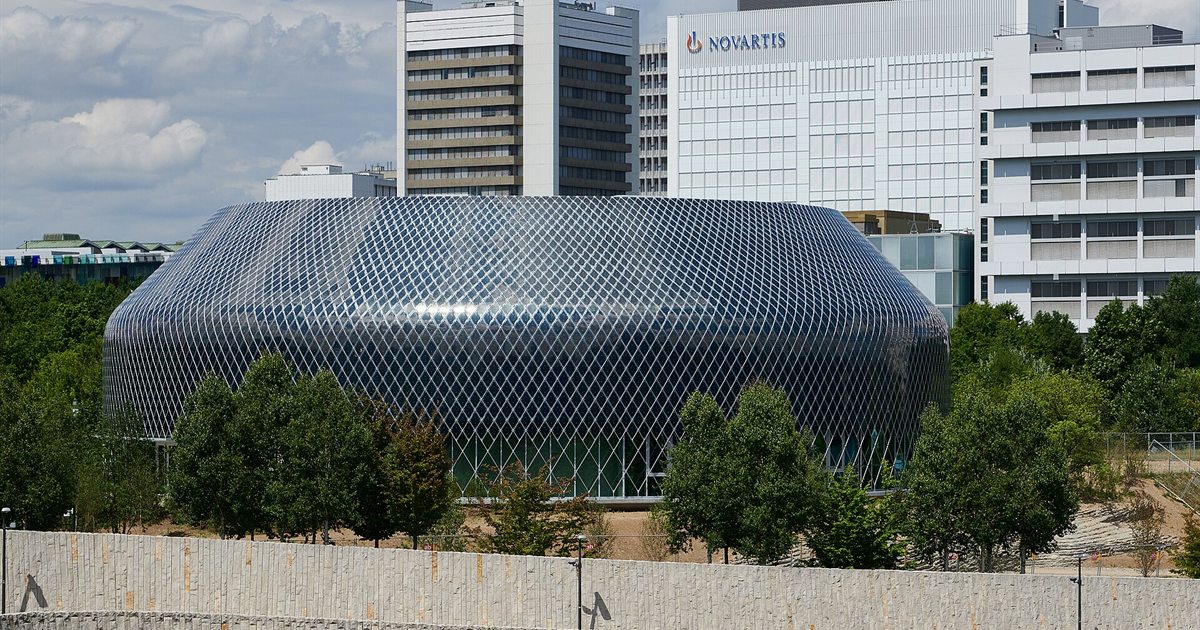
Photo: MBxd1 / Wikimedia Commons, CC BY-SA 4.0, cropped
Novartis Took a $1.9 Billion Hit and Profit Fell 70%, Yet It Raised Guidance and the Stock Rose. Here's Why
- Novartis's Q3 2026 net sales rose 4% to $14.5 billion. Volume added 14 points; generic competition cut 9 points.
- Core operating income rose 11% to $6.0 billion, a 41.6% margin. Core EPS was $2.46, up 9%.
- Reported operating income fell 59% to $1.8 billion and net income fell 70% to $1.2 billion, mainly due to a $1.9 billion partial impairment of the del-desiran drug asset.
- Late-stage trials of del-desiran (myotonic dystrophy) and pelacarsen (Lp(a) heart risk) missed their primary endpoints.
- Novartis raised its 2026 core operating income outlook to flat to low single-digit growth (from a low single-digit decline). Shares rose about 2%.
Two stories in one quarter
Novartis reported third-quarter results on Tuesday, October 27, and the headline numbers looked bad:
- Reported operating income: down 59% to $1.8 billion
- Net income: down 70% to $1.2 billion
Yet the shares rose about 2%, and the company raised its full-year profit outlook. Here's why both things are true.
The underlying business grew
| Measure | Q3 2026 | Change (constant currency) |
|---|---|---|
| Net sales | $14.5 billion | +4% |
| Core operating income | $6.0 billion | +10% |
| Core margin | 41.6% | +2.0 pts |
| Core EPS | $2.46 | +8% |
| Free cash flow | $5.1 billion | −18% (USD) |
Source: Novartis Q3 2026 results, Form 6-K.
Volume growth from newer drugs added 14 percentage points to sales, while generic competition took away 9 points.
The growth drivers
| Drug | Use | Q3 sales | Growth (cc) |
|---|---|---|---|
| Cosentyx | Psoriasis, arthritis | $1,857M | +9% |
| Kisqali | Breast cancer | $1,821M | +37% |
| Kesimpta | Multiple sclerosis | $1,484M | +22% |
| Pluvicto | Prostate cancer | $674M | +20% |
| Scemblix | Leukemia | $593M | +67% |
| Leqvio | Cholesterol | $506M | +63% |
| Entresto | Heart failure | $1,165M | −38% |
Kisqali got another boost: six-year data from the NATALEE trial showed an overall survival benefit in early breast cancer.
Entresto is the drag. It's losing sales to US generics, a classic patent cliff. Our explainer on pharma patent cliffs covers why this happens to every big drug eventually.
Where the profit went
The big hit was a $1.9 billion partial impairment of del-desiran, an experimental drug for myotonic dystrophy type 1. Its Phase III trial, HARBOR, missed its primary endpoint, although secondary measures showed some activity.
A second big trial also failed: pelacarsen, aimed at lowering heart risk from high Lp(a) cholesterol, missed on cardiovascular events in its HORIZON study. A Phase III study of remibrutinib in myasthenia gravis was stopped for futility, though the drug succeeded in two multiple sclerosis trials.
An impairment means Novartis wrote down the value of an asset it paid for, here a drug it acquired. No cash leaves the company today, but it's an admission that past spending won't pay off as hoped.
Why the stock rose anyway
- Guidance went up. Novartis now expects 2026 core operating income to be flat to up low single digits, versus a low single-digit decline before.
- The growth drugs are delivering. Kisqali, Scemblix and Leqvio more than offset Entresto.
- Buybacks continue. Novartis has bought back $4.7 billion of stock this year, with up to $4.9 billion left on its $10 billion program.
CEO Vas Narasimhan said Novartis is "well on track to deliver our mid- and long-term outlook."
What it means for you
Learn to read "core" vs "reported." Pharma companies report both. Core shows the trend; reported shows what research failures cost. Look at both before reacting to a headline.
Pipeline failures are normal. Most late-stage drugs never make it. Big pharma companies spread that risk across dozens of programs, which is why a diversified healthcare ETF is usually safer than betting on a single drug.
Healthcare as a diversifier: Pharma stocks tend to hold up better than tech in downturns. If your portfolio is tech-heavy, healthcare can balance it.
What to watch next
- Q4 2026 results in early 2027 and 2027 guidance.
- Kisqali uptake after the survival data.
- How fast Entresto generics erode US sales.
Frequently asked questions
Why did Novartis profit fall in Q3 2026?
Reported operating income fell 59% and net income fell 70% mainly because of a $1.9 billion partial impairment of the del-desiran research asset after its Phase III trial missed its primary endpoint, plus higher interest expense. The underlying business grew.
Did Novartis raise its 2026 guidance?
Yes. Novartis now expects 2026 core operating income to be in line with 2025 or grow at a low single-digit rate in constant currencies, up from a low single-digit decline. Net sales guidance of low single-digit growth was unchanged.
Which Novartis drugs are growing fastest?
In Q3 2026, in constant currencies: Scemblix +67%, Leqvio +63%, Kisqali +37%, Kesimpta +22%, Pluvicto +20% and Cosentyx +9%. Kisqali sales were about $1.8 billion in the quarter.
Why are Entresto sales falling?
Entresto, Novartis's heart failure drug, faces generic competition in the US. Its sales fell 38% to about $1.17 billion in the quarter, and generic erosion across the portfolio cut about 9 percentage points from group sales growth.
What is the difference between core and reported earnings?
Core earnings exclude items like amortization, impairments and restructuring charges that companies consider non-recurring. They show the underlying trend, but impairments represent real money spent on research that didn't pay off, so investors should look at both.
Primary sources
Data & disclaimer: This article is for educational purposes only and is not financial or investment advice. Figures reflect data available as of Oct 28, 2026, and conditions change — always confirm current pricing, rates and rules with the provider before you act. Written by Elizabeta Dimoska. See our editorial standards and disclosure.
Comments