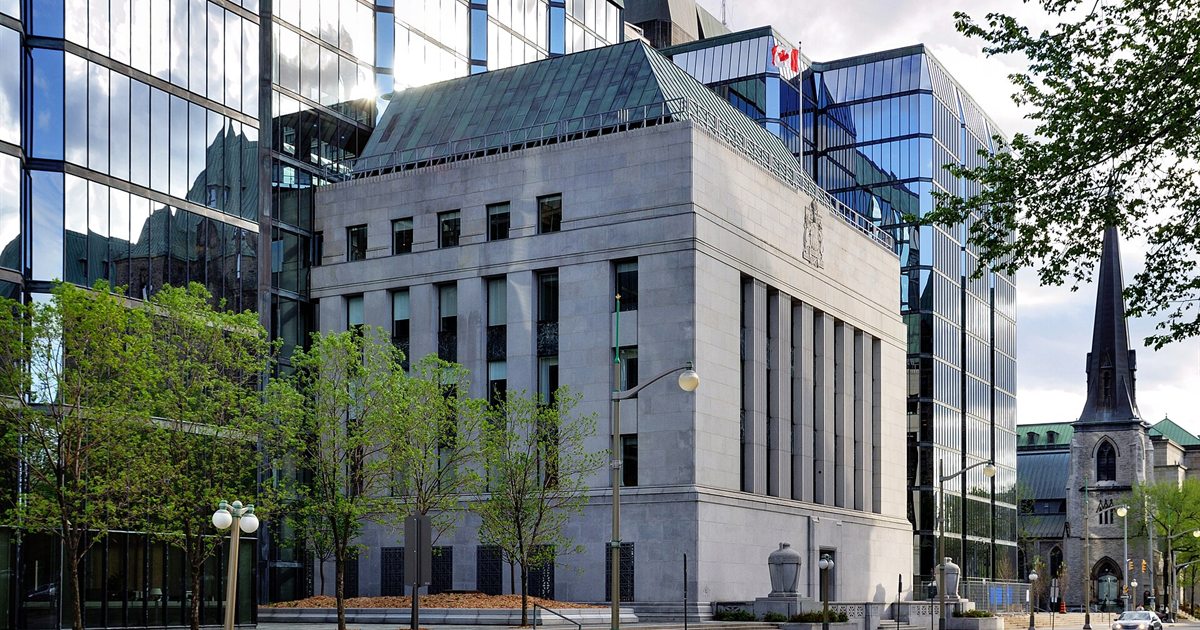
Photo: Wladyslaw / Wikimedia Commons, CC BY-SA 3.0, cropped
Bank of Canada October 28 Decision: Cut, Hold or Hike? Why Economists Can't Agree This Time
- The Bank of Canada's policy rate is 2.25%. It has not moved since October 29, 2025.
- The next decision is Wednesday, October 28, 2026, at 9:45 a.m. ET, with a new Monetary Policy Report.
- Canada lost 68,000 jobs in September. Unemployment rose to 6.5%.
- Inflation was 3.0% in August. The September CPI comes out October 19, the last big number before the decision.
- Market pricing in early October leaned to a hold, with roughly one-in-four to one-in-three odds of a hike. Some economists argue for a cut.
The short version
On October 28, the Bank of Canada will decide whether to change its key interest rate from 2.25%. Usually economists roughly agree on what's coming. This time, there's a real case for all three outcomes.
That rate matters to you. It sets the interest on variable-rate mortgages, home equity lines of credit and savings accounts, and it moves the Canadian dollar.
The case for a cut
Jobs are disappearing. Canada lost 68,000 jobs in September, after losses in August. Statistics Canada says the economy has now given back all the jobs it added in 2026. Unemployment is 6.5%, right where it started the year. Quebec lost 49,000 jobs and British Columbia 20,000. Alberta added 23,000.
Growth is weak. National Bank expects the economy to grow just 0.7% this year.
Underlying inflation is low. Core inflation, which strips out volatile items, dipped below 2% in June for the first time since 2020.
When jobs are falling and growth is soft, a central bank's usual move is to lower rates to make borrowing cheaper. Some forecasters now call a cut the most defensible choice. See our report on the September jobs data.
The case for a hold
Headline inflation is 3.0%. That was August's figure, above the Bank's 2% target, mainly because of fuel prices.
The Bank likes more evidence. It has held at 2.25% for a full year. One bad jobs report rarely flips that by itself. TD Economics and TD Securities both expect the rate to stay at 2.25%.
A cut would hurt the loonie. The Canadian dollar is already near an 18-month low against the US dollar. Cutting while the Fed raises would widen the gap and push it lower, which makes imports more expensive.
Market pricing in early October put the odds of a hold at around 70% to 75%.
The case for a hike
The Fed is still raising. The US central bank lifted its rate to 3.75%–4.00% in September and may go again. The gap between the two countries is the widest in years. We explain why that matters in the BoC–Fed rate gap.
Oil is above $100. Fuel costs feed into everything from groceries to airfares.
Traders priced roughly a one-in-four to one-in-three chance of a hike in early October. With unemployment rising, few economists expect one this month.
The data that will decide it
| Date | Release | Why it matters |
|---|---|---|
| October 14 and 16 | Governor Macklem speaks in Bangkok | His remarks are not being published, so watch news coverage for hints |
| October 16 | CREA home sales for September | Shows whether housing is cooling further |
| October 19 | September Consumer Price Index | The single most important number before the decision |
| October 28, 9:45 a.m. | Rate decision and Monetary Policy Report | New forecasts for growth and inflation |
What each outcome means for you
| If the Bank... | Variable mortgage & HELOC | Savings & GICs | Canadian dollar |
|---|---|---|---|
| Cuts to 2.00% | Payments fall | Savings rates drift lower; lock GICs before | Likely weaker |
| Holds at 2.25% | No change | No change | Little effect |
| Hikes to 2.50% | Payments rise | Rates rise | Likely stronger |
If you have a variable-rate mortgage: Don't panic either way. A quarter-point move changes the payment on a $500,000 mortgage with 25 years left by roughly $70 a month.
If you're renewing a fixed mortgage: Fixed rates follow five-year bond yields, not the Bank's rate directly. Those yields have risen with global rates. Our guide to how bond yields set mortgage rates explains the link.
If you're holding cash: If you think a cut is coming, locking in a GIC now keeps today's rate. Compare options in GIC vs HISA vs cash ETFs.
Frequently asked questions
When is the next Bank of Canada rate decision?
Wednesday, October 28, 2026, at 9:45 a.m. Eastern Time. The Bank also publishes its quarterly Monetary Policy Report that morning, with new forecasts for growth and inflation.
What is the Bank of Canada interest rate right now?
The policy rate, also called the overnight rate, is 2.25%. The Bank cut it to that level on October 29, 2025, and has held it there at every decision since, including September 2026.
Will the Bank of Canada cut rates in October 2026?
A cut is possible but is not the market's base case. Two months of heavy job losses support one. Inflation at 3.0% in August and a US Federal Reserve that is still raising rates argue against it. Market pricing in early October leaned toward a hold, and the September inflation report on October 19 will matter most.
Could the Bank of Canada raise rates?
Traders priced roughly a one-in-four to one-in-three chance of a hike in early October, mainly because of oil-driven inflation and pressure from higher US rates. With unemployment rising to 6.5%, most economists see a hike as unlikely this month.
What does the Bank of Canada decision mean for my mortgage?
Variable-rate mortgages and lines of credit move with the Bank's rate, so a cut lowers your payment and a hike raises it. Fixed mortgage rates follow five-year Government of Canada bond yields instead, which have been pushed up by rising global yields.
Primary sources
- Bank of Canada — Press releases and schedule
- Bank of Canada — Fireside chat with Governor Tiff Macklem, October 14, 2026
- CTV News — Canada loses all 2026 job gains
- TD Economics — Weekly Bottom Line
- FXStreet / TD Securities — Bank of Canada: policy path steady with cautious inflation stance (Oct. 12, 2026)
- National Bank of Canada — Monthly Economic Monitor, September 2026
Data & disclaimer: This article is for educational purposes only and is not financial or investment advice. Figures reflect data available as of Oct 14, 2026, and conditions change — always confirm current pricing, rates and rules with the provider before you act. Written by Elizabeta Dimoska. See our editorial standards and disclosure.
Comments