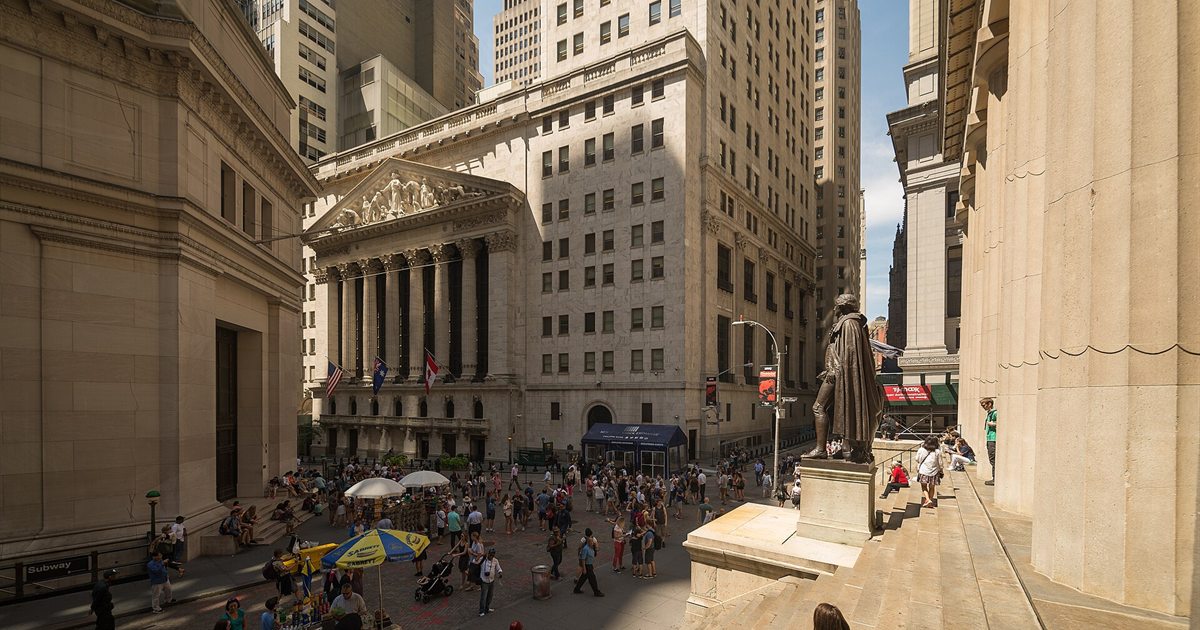
Photo: Arild Vågen / Wikimedia Commons, CC BY-SA 4.0, cropped
Black Monday 1987: What Happened When the Dow Fell 22.6% in One Day, and Could It Happen Again?
Black Monday was October 19, 1987, when the Dow Jones Industrial Average fell 508 points, or 22.6%, to 1,738.74, still its largest one-day percentage drop ever. The S&P 500 fell about 20.5%. Markets around the world crashed the same day. There was no single trigger: stocks had climbed more than 40% in 1987 by their August peak and looked expensive, interest rates and the dollar were worrying investors, and a computer-driven hedging strategy called portfolio insurance automatically sold more as prices fell, feeding a downward spiral that overwhelmed the market's plumbing. The Federal Reserve promised to provide liquidity the next morning, and the market stabilized. The Dow regained its pre-crash high in about two years. Afterward, regulators created circuit breakers: today, US stock trading halts for 15 minutes if the S&P 500 falls 7% or 13% in a day, and closes for the day at 20%. A crash of that size today would mean a drop of roughly 11,700 points on the Dow. It could happen again, but long-term investors who held on in 1987 were made whole.
October 19, 1987
Thirty-nine years ago this week, Wall Street had the worst day in its modern history.
On Monday, October 19, 1987, the Dow Jones Industrial Average fell 508 points, or 22.6%, closing at 1,738.74. The broader S&P 500 fell about 20.5%. That's still the Dow's biggest one-day percentage drop ever, larger than any single day in 1929.
The crash was global. Markets in Hong Kong, Australia, London and elsewhere fell sharply the same day or the next.
What caused it?
There was no war, no bank collapse and no single piece of bad news. Instead, several things lined up.
1. Stocks had run up fast
By its August peak the Dow had climbed more than 40% in 1987, and valuations looked stretched. It had already slipped well off that high by mid-October.
2. Worries about rates and the dollar
Interest rates were rising. The US had a large trade deficit, and there were fears the dollar would fall further. The market fell hard in the week before Black Monday, including about 4.6% on Friday, October 16.
3. Portfolio insurance
This was the accelerant. Many big institutions used portfolio insurance, a computer-driven strategy that automatically sold stock index futures as the market fell, to limit losses.
When prices dropped, the models sold. Selling pushed prices lower, so the models sold more. Arbitrage traders then sold actual stocks to match futures prices. It became a feedback loop.
4. The plumbing broke
Order volumes overwhelmed the exchanges. Specialists couldn't keep up, quotes went stale, and many investors couldn't trade at all, which added to the panic.
The government's Brady Commission later concluded that a relatively small number of institutions, mostly using portfolio insurance, accounted for a large share of the selling.
How the market recovered
On the morning of Tuesday, October 20, the Federal Reserve, under new chair Alan Greenspan, said it stood ready to provide liquidity to support the economic and financial system. Banks kept lending to brokers, and the market stabilized.
| Milestone | What happened |
|---|---|
| Oct. 19, 1987 | Dow falls 22.6% to 1,738.74 |
| Oct. 20-21, 1987 | Fed steps in; the Dow posts a big rebound on Oct. 21 |
| Dec. 31, 1987 | Dow ends the year slightly up for 1987 |
| Around mid-1989 | Dow regains its August 1987 high |
Sources: Federal Reserve History, Brady Commission report.
There was no recession. The economy kept growing, and the 1990s brought one of the longest bull markets on record. Investors who held on were made whole within roughly two years.
Circuit breakers: the safety switches born from 1987
After Black Monday, regulators created circuit breakers, automatic pauses that give investors time to think.
| Level | S&P 500 drop from prior close | What happens |
|---|---|---|
| Level 1 | 7% | 15-minute halt (if before 3:25 p.m. ET) |
| Level 2 | 13% | 15-minute halt (if before 3:25 p.m. ET) |
| Level 3 | 20% | Trading stops for the rest of the day |
Source: SEC and NYSE.
Individual stocks also have limit up-limit down bands that pause trading if a single stock moves too far too fast.
Under the current rules, market-wide circuit breakers have been triggered four times, all in March 2020 during the Covid crash. Other markets have their own versions. When Indonesia's market fell 11.6% on October 16, 2026, after an MSCI downgrade warning, trading was halted for 30 minutes (story).
Could it happen again?
Yes, a crash is always possible. Markets have had sudden drops since 1987:
- 1989 "mini-crash": the Dow fell about 7% on October 13.
- 2010 Flash Crash: the Dow dropped about 1,000 points in minutes before recovering.
- March 16, 2020: the Dow fell about 13% in a day as Covid spread.
What's different now:
- Circuit breakers would halt trading at 7%, 13% and 20%, so a single-day 22.6% fall like 1987 is less likely in the US.
- Central banks have a well-tested playbook for providing liquidity.
- New risks have emerged: high-speed algorithmic trading, leveraged ETFs, concentration in a few giant tech stocks, and AI-related debt. Mid-October 2026's AI selloff, when chip stocks fell for eight straight days, is a reminder that crowded trades can unwind fast.
In today's numbers: a 22.6% drop from a Dow near 52,000 would be roughly 11,700 points. A 20.5% fall in the S&P 500 near 7,700 would be about 1,580 points.
What to do if it happens
- Don't panic-sell. In 1987, selling on the day locked in the loss right before a rebound.
- Keep your emergency fund in cash, so you never have to sell stocks in a crash.
- Keep buying on schedule. Crashes are when regular investing pays off most. See dollar-cost averaging through crashes.
- Rebalance if your stock allocation has drifted far below target.
- Read our guide on what to do when the market has crashed.
The bottom line
Black Monday showed how fast fear can feed on itself, especially when automated strategies all sell at once. It also showed something more useful for long-term investors: the economy didn't collapse, the market recovered within about two years, and those who stayed invested were rewarded.
This article is educational and not personalized investment advice.
Frequently asked questions
What happened on Black Monday 1987?
On Monday, October 19, 1987, the Dow Jones Industrial Average fell 508 points, or 22.6%, to 1,738.74. It remains the largest one-day percentage decline in the Dow's history. The S&P 500 fell about 20.5%, and stock markets from Hong Kong to London crashed the same day.
What caused Black Monday?
There was no single cause. Stocks had risen sharply and looked overvalued, interest rates were rising, the US trade deficit and a weakening dollar worried investors, and the market had already fallen the previous week. Computer-driven portfolio insurance, which sold stock index futures automatically as prices fell, added a wave of selling that the market couldn't absorb.
What is portfolio insurance?
Portfolio insurance was a hedging strategy popular with big institutions in the 1980s. It used computer models to sell stock index futures as prices fell, to limit losses. When many institutions did it at once, their selling pushed prices lower, which triggered more selling, creating a feedback loop.
How long did it take the stock market to recover from Black Monday?
The Dow closed at its pre-crash high of August 1987 again by around mid-1989, roughly two years later. The 1987 calendar year actually ended with a small gain for the Dow. Investors who kept holding were made whole within a couple of years and benefited from the long bull market of the 1990s.
What are stock market circuit breakers?
Circuit breakers are automatic trading halts. In the US, if the S&P 500 falls 7% from the prior close (Level 1) or 13% (Level 2) before 3:25 p.m. Eastern, trading stops for 15 minutes. If it falls 20% (Level 3) at any time, trading stops for the rest of the day. Individual stocks also have limit up-limit down bands.
Could a Black Monday crash happen again?
A sudden crash is still possible, as shown by the 2010 Flash Crash and the March 2020 Covid selloff, when circuit breakers were triggered four times. But circuit breakers and a central bank ready to act make a single-day 22% fall less likely in the US. A repeat today would mean a drop of roughly 11,700 points on a Dow near 52,000.
What should I do if the stock market crashes?
Avoid panic selling. Check that your emergency fund is in cash, not stocks. If you invest for the long term, keep buying on schedule, because crashes let you buy more shares at lower prices. Rebalance if your mix has drifted far from your plan. Only sell if you genuinely need the money soon or your plan has changed.
Primary sources
Data & disclaimer: This article is for educational purposes only and is not financial or investment advice. Figures reflect data available as of Oct 20, 2026, and conditions change — always confirm current pricing, rates and rules with the provider before you act. Written by Elizabeta Dimoska. See our editorial standards and disclosure.
Comments